
DMT EDUCATION
DMT Vaporization Science: Understanding How Inhaled DMT Is Studied
Aug
DMT vaporization science brings together chemistry, pharmacology, aerosol science, and vaporization technology to examine what happens when DMT is converted from a liquid or solid form into an inhaled aerosol.
Research into inhaled DMT is not limited to the subjective experience associated with psychedelics. Scientists can also study how the compound enters the body, how quickly it becomes available in the bloodstream, how it is metabolized, and how it interacts with receptors in the nervous system.
The technology used for vaporization is an important part of this process. A vaporization system involves physical components that generate heat and create an aerosol, while the pharmacological effects depend on the properties of DMT and its interaction with biological systems.
This distinction is important when discussing DMT vaporization science. Hardware explains the physical delivery process, whereas pharmacology explains what happens after the compound enters the body. See DMT Vape
Researchers can therefore approach inhaled DMT from several different perspectives, including aerosol formation, pharmacokinetics, receptor activity, brain function, and subjective effects.
How Vaporization Changes the Physical Form of DMT
Vaporization involves the application of heat to a substance so that components can enter the gas phase or become part of an aerosol. Electronic vaporization systems add another layer because the heating process occurs within a small engineered device.
The resulting aerosol is different from the original stored material. Its physical characteristics depend on factors including the chemical properties of the formulation, the materials surrounding the heating area, and the conditions under which aerosol formation occurs.
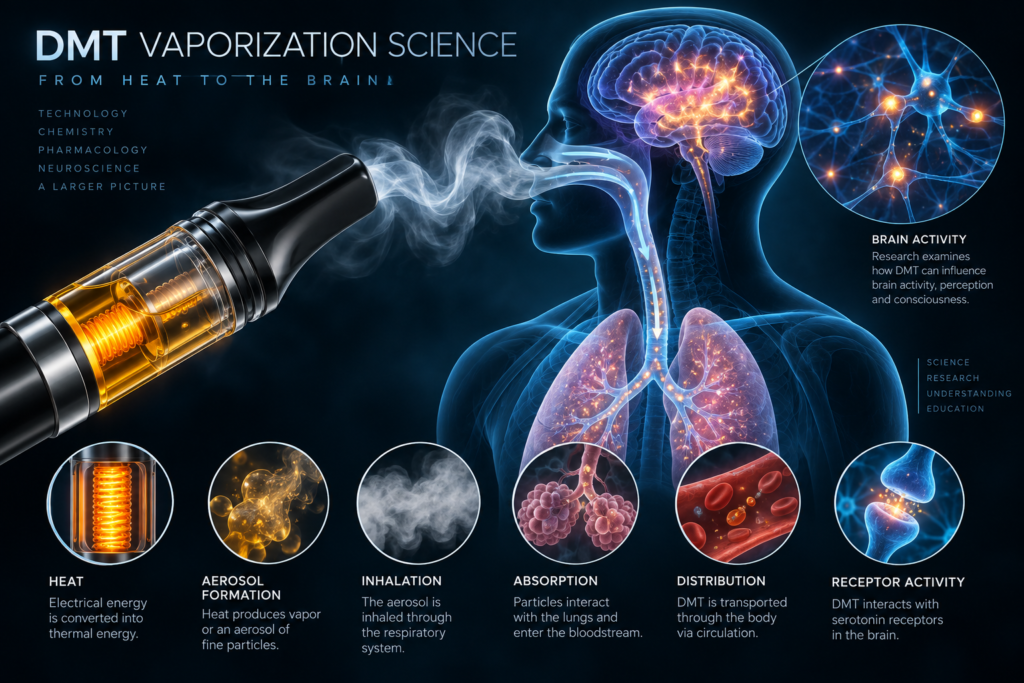
In a cartridge-based system, electrical energy is converted into thermal energy by a heating element. Heat is transferred to material in the surrounding region, producing an aerosol that can travel through the device’s airflow pathway.
This is why DMT vaporization science involves more than simply asking whether a substance can be heated. Researchers are interested in the physical transformation itself and how that transformation relates to absorption and pharmacology.
From a scientific perspective, the vaporization stage can be considered one part of a larger sequence:
Material → Heat transfer → Aerosol formation → Inhalation → Absorption → Distribution → Pharmacological effects
Each stage represents a different scientific question. Studying them separately helps researchers understand the relationship between vaporization technology and the biological effects associated with inhaled DMT.
DMT Aerosol Formation Explained
Aerosol formation is an important part of understanding the science of inhaled substances. An aerosol consists of very small particles or droplets suspended in a gas, and its physical properties can differ from those of the original material.
In a vaporization system, the heating element provides thermal energy to material in its immediate environment. Depending on the substance and surrounding conditions, this can produce vapor, condensed droplets, or a combination that forms an aerosol.
For researchers studying DMT vaporization, this physical transformation matters because the characteristics of the resulting aerosol can influence how a substance behaves during inhalation.
Cartridge architecture can also play a role. Components such as the heating element, liquid-transfer system, reservoir, and airflow pathway form a connected system that determines how material moves through the device.
This is one reason DMT aerosol formation is a useful topic within broader vaporization research. It connects the engineering side of cartridge technology with the biological side of inhaled substance research.
dmt cartridges | x pills for sale | dmt vapes for sale | buy blue dolphin ecstasy pills | buy dmt online | buy dmt carts online | nn dmt for sale | buy dmt carts | psychotria viridis leaves for sale | dmt cart price | chacruna leaves for sale | buy mdma crystals online | dmt 1ml purecybin – 700mg dmt | dmt powder for sale | buy dmt | 5-meo-dmt buy | order dmt online | buy dmt crystals online | buy blue crystal meth online | buy dmt vape juice online | rolls royce pill | dmt cartridge and battery | buy pure dmt | buy ketamine type s
How Inhaled DMT Is Studied
Scientists can study inhaled DMT using several complementary approaches. Pharmacokinetic research examines how the compound is absorbed, distributed, metabolized, and eliminated by the body. Pharmacodynamic research focuses on how DMT interacts with biological targets and produces measurable effects.
Researchers may also examine physiological measurements, subjective reports, cognitive changes, and changes in brain activity. Together, these approaches help create a broader picture of how inhaled DMT interacts with the human body.
One important concept is bioavailability, which refers to the proportion of a substance that reaches systemic circulation and is available to produce biological effects. The route through which a substance enters the body can influence its absorption and resulting pharmacokinetic profile.
Research can therefore distinguish between the physical process of vaporization and the subsequent biological processes of absorption and distribution.
This distinction is particularly important when interpreting information online. A discussion about vaporization hardware does not automatically describe DMT’s pharmacological effects, and findings from one research setting cannot necessarily be generalized to every type of vaporization system.
For that reason, DMT research is best understood by considering the chemistry, delivery method, pharmacology, and experimental conditions together.
DMT Pharmacology and Inhalation
Once inhaled DMT reaches the body, the subject moves from vaporization science into pharmacology. Researchers study how DMT interacts with biological systems, including receptors involved in serotonin signaling.
DMT is classified as a serotonergic psychedelic, and its activity at several serotonin receptors is an important area of pharmacological research. Scientists investigate these receptor interactions alongside changes in perception, cognition, mood, and brain activity.
The inhaled route is particularly relevant to pharmacokinetic research because the body can absorb substances through the respiratory system. Researchers can examine the relationship between absorption and the timing of measurable physiological or subjective effects.
This makes DMT pharmacology an important companion topic to DMT vaporization science. Vaporization describes a physical process, while pharmacology examines what happens after the compound becomes available to biological systems.
DMT Vaporization and the Brain
Research into DMT and the brain has expanded beyond traditional pharmacology. Modern studies can examine changes in brain activity, connectivity, perception, and the subjective experience associated with psychedelic states. See DMT Cart
Scientists are particularly interested in how psychedelic compounds can temporarily alter patterns of brain activity and communication between different neural networks.
However, the relationship between these changes and the subjective experience remains an active area of research. Researchers continue to investigate whether particular patterns of neural activity can explain changes in perception, sense of time, self-awareness, and consciousness.
This is why DMT vaporization science sits at the intersection of several disciplines. Understanding inhaled DMT requires consideration of the physical vaporization process, pharmacokinetics, receptor pharmacology, neuroscience, and psychology.
The technology used to produce an aerosol is therefore only one part of a much larger scientific picture.
Why DMT Vaporization Research Matters
Studying vaporized DMT can help researchers understand the relationship between physical delivery, pharmacology, and effects on the nervous system.
Research in this area can contribute to broader scientific questions about psychedelic compounds, altered states of consciousness, receptor activity, and the relationship between brain activity and subjective experience.
The research also highlights the importance of separating established findings from unanswered questions. Scientists have learned more about DMT pharmacology and psychedelic neuroscience, but many aspects of the DMT experience and its relationship to consciousness still require further investigation.
As research develops, improved analytical methods and controlled studies may provide additional information about inhaled DMT, its pharmacokinetics, and its effects on brain function.
Conclusion
DMT vaporization science combines vaporization technology with chemistry, pharmacology, neuroscience, and aerosol science.
The physical process begins with heat and aerosol formation, but the scientific picture continues through absorption, distribution, receptor activity, and changes in brain function. Each stage gives researchers a different perspective on inhaled DMT.
Understanding these distinctions makes it easier to evaluate information about DMT critically and recognize the difference between established scientific findings and areas that still require further research. See DMT Products
Frequently Asked Questions
What is DMT vaporization science?
DMT vaporization science examines the physical, chemical, and biological processes associated with delivering DMT in vapor or aerosol form.
What happens when DMT is vaporized?
Vaporization applies thermal energy to DMT-containing material and can produce vapor or an aerosol. Researchers can then examine the resulting material in relation to inhalation and subsequent pharmacological processes.
What is DMT aerosol formation?
DMT aerosol formation describes the production of very small droplets or particles suspended in a gas during the vaporization process.
How do researchers study inhaled DMT?
Researchers can examine pharmacokinetics, pharmacodynamics, physiological measurements, subjective effects, and neurological activity to investigate inhaled DMT.
What is the relationship between DMT vaporization and pharmacology?
Vaporization describes the physical delivery process, while pharmacology examines how DMT interacts with biological systems after the body absorbs the compound.
Does DMT research continue to develop?
Yes. Researchers continue to investigate DMT pharmacology, psychedelic neuroscience, brain activity, subjective experiences, and questions surrounding consciousness.
